Injury Prevention and injury reduction in Training.
Injury prevention isn’t a separate program — it should be intertwined into your workouts. By integrating key movements and strategies into training, we can reduce injury risk without sacrificing performance.
Identify areas of need specific to your sport or athletes and implement exercises that target those vulnerabilities.
Train the body in balance — front to back, left to right, and top to bottom. Balanced athletes are more durable athletes.
There are a few foundational movements I’d highly recommend for supporting injury prevention. I personally weave these into every training session I run, they’re simple, effective, and proven over time.
Stay tuned — I’ll be sharing specific examples and how to implement them into your current program.
1. Neck
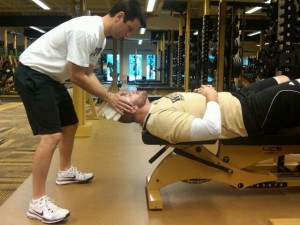
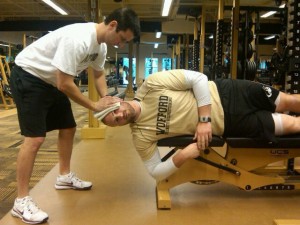
4-Way Neck Exercises (Front, Side, Side, Back)
Target Muscles:
-
Front: Sternocleidomastoid, deep neck flexors
-
Sides: Lateral neck flexors (scalenes, sternocleidomastoid)
-
Back: Upper trapezius, cervical extensors
Purpose:
-
Improve neck strength and stability
-
Enhance posture and reduce risk of neck injury (especially in contact sports)
-
Support concussion prevention through stronger neck musculature
2. Shoulders
Shoulder Protraction & Retraction
Target Muscles:
-
Protraction: Serratus anterior
-
Retraction: Rhomboids, middle/lower trapezius
Purpose:
Improve scapular control, posture, shoulder stability, and prevent shoulder injuries.
Shoulder Protraction (Serratus Punch)
Setup:
-
Hold a light resistance band, dumbbell, or no weight (for beginners).
-
Lie on your back or stand tall with arms extended straight in front of you at shoulder height (palms facing in).
-
Keep your elbows straight throughout the movement.
Movement:
-
From the starting position, reach forward by pushing your shoulder blades away from your spine (like you’re trying to punch the air).
-
Hold the end position briefly, feeling your shoulder blades “wrap” around your ribcage.
-
Slowly return to the start by bringing your shoulder blades back to neutral — but do not bend your elbows.
Reps: 2–3 sets of 10–15 reps
Shoulder Retraction (Scapular Squeeze)
Setup:
-
Sit or stand with good posture, or lie prone (on your stomach).
-
Arms can be extended in front, by your side, or holding a light resistance band or cable.
-
Keep your elbows straight (unless using a row variation).
Movement:
-
Pull your shoulder blades together (like you’re trying to pinch a pencil between them).
-
Keep your shoulders relaxed — avoid shrugging.
-
Hold the squeeze for 1–2 seconds.
-
Slowly release back to the starting position under control.
Reps: 2–3 sets of 10–15 reps
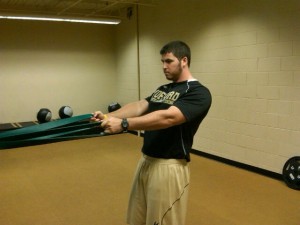


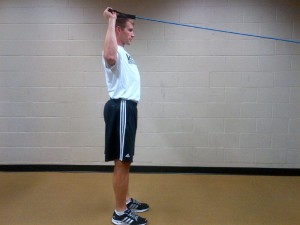
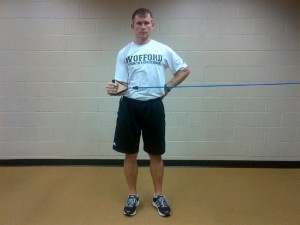
4 Way External Shoulder Rotation (with Band)
Target Muscle:
-
Infraspinatus and Teres Minor (part of the rotator cuff)
-
Assists in shoulder stability and injury prevention
Purpose:
Improve rotator cuff strength, enhance shoulder stability, and prevent overuse injuries — especially important for overhead athletes.
Setup (Band Version):
-
Attach a light resistance band to a fixed point at elbow height.
-
Stand sideways to the anchor point, holding the band in the hand farthest from the anchor.
-
Bend your elbow to 90 degrees, keeping your upper arm tight to your side (you can place a rolled towel between your elbow and torso for proper form).
-
Your forearm should start across your stomach (neutral position).
Movement:
-
Rotate your arm outward, away from your body, keeping your elbow tight to your side.
-
Move slowly and with control, stopping when your forearm is roughly parallel to your torso.
-
Pause briefly at the end range.
-
Slowly return to the starting position.
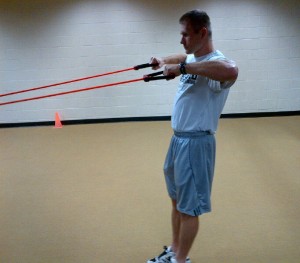
Banded Rear Deltoid Exercise (Reverse Fly / Pull-Apart)
Target Muscles:
-
Rear deltoids (posterior deltoid)
-
Rhomboids
-
Middle trapezius
Purpose:
Improve posture, strengthen the rear shoulder, and support shoulder joint stability — especially important for balancing pressing movements.

SHOULDER – OSCILLATORY RESISTANCE TRAINING – Holding the bar in the center with one hand and shaking it, causing the bar to vibrate rapidly. The hand and arm 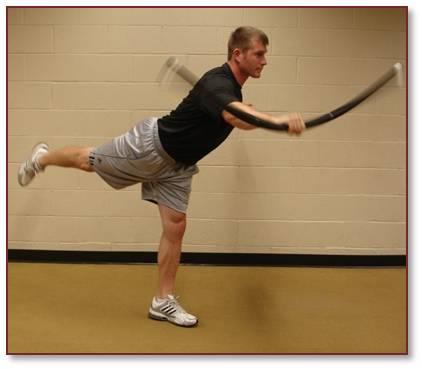 are held in various positions, offering a remarkable effective ways to strengthen and condition the muscle fibers and sensory receptors of the shoulder joint. The goal is to train in all different planes (Frontal, Sagital & Transverse) hitting all the minor muscles surrounding the shoulder joint. (Note: We are trying to train the minor muscles of this joint for stabilization) In this picture we are using the Collegiate Series Body Bar Flex
3. Hips & Glutes
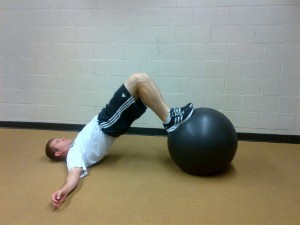
Balance Ball Leg Curl (Swiss Ball Hamstring Curl)
Target Muscles:
-
Hamstrings
-
Glutes
-
Core
Purpose:
Develop posterior chain strength, improve hip stability, and enhance hamstring control — great for both performance and injury prevention.
Hip Lift (Glute Bridge or Med Ball Buck / Supine Hip Lift)
Target Muscles:
-
Glutes (gluteus maximus)
-
Hamstrings
-
Core (stabilization)
-
Lower back (isometric support)
Purpose:
Activate and strengthen the glutes, stabilize the pelvis, and improve hip extension. It’s excellent for correcting muscle imbalances, especially for people who are quad- or hip-flexor dominant.

Hip Stability – Lateral Band Walks
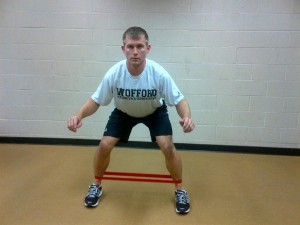
Banded Lateral Walk
Target Muscles: Gluteus medius, gluteus minimus, hip abductors
Purpose: Hip stability, glute activation, injury prevention (especially for knees and hips)
Setup:
-
Place a resistance band just above your knees or around your ankles (more challenging around the ankles).
-
Stand with your feet shoulder-width apart and knees slightly bent.
-
Engage your core and hinge slightly at the hips (athletic stance).
Movement:
-
Step laterally (sideways) with your lead foot, keeping tension on the band.
-
Follow with your trailing foot, not allowing your feet to fully come together—keep tension on the band the entire time.
-
Take 5–10 controlled steps in one direction, then repeat in the opposite direction.
-
Keep your knees in line with your toes and avoid letting them cave inward.
Coaching Cues:
-
Stay low in an athletic stance
-
Keep your core engaged
-
Move slow and controlled — don’t drag your feet
-
Feel the burn in the side glutes, not the thighs
Reps:
-
2–3 sets of 10–15 steps in each direction
4. Ankles
Band Ankle Inversion
Target: Tibialis posterior, ankle stabilizers
Purpose: Strengthen muscles that control inward ankle motion (helps prevent ankle sprains)
Instructions:
-
Sit on the floor or a bench with your leg extended.
-
Loop a resistance band around the inside of your forefoot (ball of your foot), and anchor the other end of the band to a sturdy object to your side (outside of your foot).
-
Start with your foot in a neutral position (pointing straight up).
-
Slowly rotate your foot inward, pulling against the resistance of the band.
-
Pause at the end range, then return slowly to the starting position.
Reps: 2–3 sets of 10–15 reps per side
Band Ankle Eversion
Target: Peroneal muscles
Purpose: Strengthen muscles that control outward ankle motion (supports lateral ankle stability)
Instructions:
-
Sit with your leg extended and loop the resistance band around the outside of your forefoot.
-
Anchor the other end of the band to a sturdy object on the inside of your foot (opposite side).
-
Start with your foot in a neutral position.
-
Slowly rotate your foot outward, away from the midline, stretching the band.
-
Pause briefly at the end range, then return under control to the start.
Reps: 2–3 sets of 10–15 reps per side
https://youtu.be/-1C_l6M-8es?si=KJDu88UWDk8olOeQ


